
What if a photo of you appeared in a video you never made? With AI-powered video tools becoming increasingly common, this unsettling possibility is no longer science fiction. Deepfake VR porn is pushing boundaries, blending fantasy with hyper-realism, but it also raises serious concerns about consent, exploitation, and personal privacy.
As these technologies spread, knowing how to protect yourself is just as important as understanding their appeal. This guide explores the pros, cons, and legal realities to help safeguard your digital safety.
How your image can be used
Deepfakes don’t appear out of thin air. They rely on real images and videos as source material. Understanding where this content comes from is the first step in protecting yourself.
One of the most common methods is social media scraping. Publicly available photos from platforms like Instagram, Facebook, or TikTok can be downloaded in bulk and fed into AI systems. Even everyday selfies or group pictures can provide enough data for a convincing deepfake.
Another risk comes from AI avatar apps. These services promise fun filters or digital doubles, but some store user submissions in ways that make them vulnerable to misuse. When you upload a face scan or portrait, you may unknowingly hand over training material for future deepfakes.
Finally, leaked private images remain a serious concern. Whether from hacked accounts, stolen cloud backups, or data breaches, personal photos meant to stay private can be weaponized once in the wrong hands. These are often used for blackmail or revenge porn, leaving victims with little control once the content spreads.
By knowing where deepfake creators get their material, you can take smarter precautions, from tightening privacy settings to being cautious about what you share online.
Proactive digital safety checklist
While you can’t control every risk online, you can take meaningful steps to reduce the chances of your image being misused in a deepfake. Building smart digital habits helps you stay ahead of potential threats and spot problems before they escalate. Start with these preventative measures:
- Audit and lock down social media privacy settings. Limit who can see and download your photos by adjusting profile visibility and restricting third-party access.
- Be cautious of apps that require photo uploads. Read the terms of service carefully, and avoid tools that store or sell facial data.
- Use services like Google Alerts on your name. Get notified if your name or image surfaces online in suspicious contexts.
- Watermark sensitive personal images before sharing them privately. Subtle watermarks make stolen content harder to repurpose convincingly.
These steps won’t eliminate risk entirely, but they’ll strengthen your digital defenses and give you more control over how your image is used.
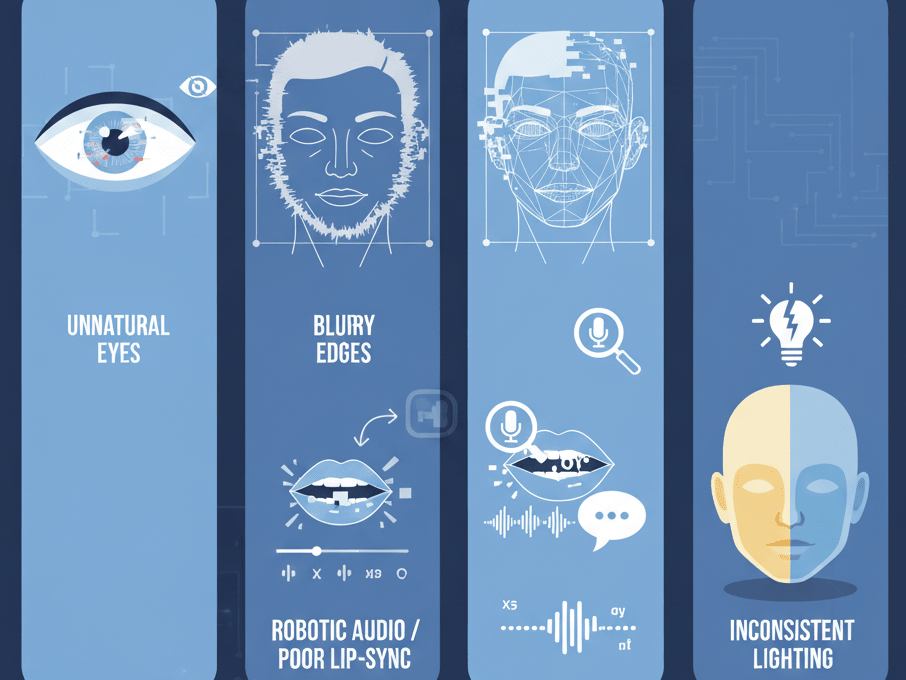
How to spot a deepfake in 2025
Even as AI technology improves, most deepfakes still carry subtle flaws that reveal they’re not real. By learning to recognize these signs, you can protect yourself from falling for manipulated content. Below are simple, non-technical tips anyone can use to spot potential fakes.
Unnatural blinking or strange eye movements
The eyes are often the biggest giveaway in a deepfake. AI systems sometimes struggle to replicate natural blinking patterns, causing subjects to blink too rarely, too often, or in an unnatural rhythm. You may also notice odd eye movements: a gaze that doesn’t quite follow the action, pupils that don’t focus correctly, or a lack of realistic eye moisture and reflections.
In some cases, the eyes might appear slightly “glassy” or detached from the rest of the face. Paying attention to these subtle details can quickly reveal when you’re looking at a digital creation rather than a real recording.
Blurry or distorted edges
Edges where the face meets the hairline, ears, or neck are notoriously difficult for AI to render seamlessly. Look closely for areas that seem slightly blurred, jagged, or inconsistent in sharpness compared to the rest of the video.
In some cases, you may notice the skin tone shifting unnaturally at the edges or the jawline appearing too soft. Hair, in particular, often looks oddly smoothed out or lacks the fine detail of individual strands.
These subtle distortions can break the illusion once you know what to look for. By scanning the borders of the face and comparing them to the surrounding image, you’ll often find the tiny imperfections that separate a fake from reality.
Robotic audio or poor lip-sync
Audio syncing remains one of the biggest challenges for convincing deepfakes. When a video looks realistic but the speech feels “off,” it’s often a sign of manipulation. Listen carefully: does the voice sound flat, robotic, or strangely compressed, as if recorded on low-quality equipment? Do the lips match the words being spoken, or do they fall slightly behind?
Even if the movements are close, you may notice unnatural pauses, mismatched syllables, or a lack of natural breathing patterns. Authentic audio carries subtle human irregularities, small variations in tone, rhythm, and emphasis, that AI-generated voices often fail to replicate. Combining mismatched lip-sync with unusual audio quality is one of the clearest red flags of a deepfake.
Inconsistent lighting
Lighting mismatches are another major giveaway. A genuine video will have consistent shadows and highlights across the face, body, and background. Deepfakes, however, often reveal subtle errors: a face that appears too bright compared to the room, shadows that don’t line up with other objects, or skin tones that shift unnaturally as the subject moves.
Watch closely for areas where the light doesn’t behave naturally. For example, a bright forehead under dim room lighting, or a jawline that lacks the same shadow as the neck. While casual viewers might overlook these details, once you train your eye, these inconsistencies become obvious signs of manipulation.
Emergency action plan: what to do if you’re a victim
Discovering that your face or image has been used in a deepfake without consent can be shocking and overwhelming. Acting quickly is the best way to limit the spread, preserve evidence, and begin the process of removal. Follow these steps to protect yourself and take back control.
1. Document everything
Before content can be removed, you’ll need proof. Take screenshots, save the URL, and record the date and time you discovered the material. Store this information securely, as it will help when reporting to platforms, authorities, or legal representatives.
2. Use official channels
In the U.S., submit a report through the Take It Down Act portal, which is designed to help minors and adults request the removal of intimate or sexually explicit content. In the EU, use the relevant reporting systems under the Digital Services Act. These official routes add legal weight to your request.
3. Report to platforms
Most social media platforms, adult sites, and hosting services provide reporting tools for non-consensual sexual content. Use these immediately to request takedowns. The faster you act, the less likely the content is to spread further.
4. Contact authorities
File a report with your local law enforcement or national cybercrime unit. Even if immediate removal isn’t guaranteed, creating a legal record strengthens your case and helps authorities track offenders when possible.
Your legal rights explained
If you ever find yourself the target of a deepfake, it’s important to know that new laws are beginning to shift power back into the hands of individuals. While enforcement is still uneven worldwide, both the EU and the U.S. have taken meaningful steps to protect people from non-consensual AI-generated content.
In Europe, the EU AI Act introduces safeguards around labeling and consent. This means that if an AI system is used to generate sexually explicit material, it must be clearly labeled as synthetic content. More importantly, it requires explicit consent before a person’s likeness can be used in AI-generated pornographic material.
For victims, this gives a stronger legal ground to demand removal if their image has been manipulated without permission. It also provides a framework for holding creators and distributors accountable when these rules are broken, even if the platform itself operates across borders.
In the United States, the Take It Down Act offers individuals a direct right to removal. If intimate or sexually explicit material featuring your likeness appears online without your consent, you can file a request through the official portal.
Once submitted, platforms are legally obligated to remove the content or face penalties. This empowers victims to act quickly without needing to hire a lawyer first. It also ensures that victims, whether minors or adults, have a recognized path to reclaim control over their digital identity.
Although these laws don’t solve every problem, they represent an important shift: your consent matters, and you now have legal tools to defend it. Knowing your rights not only helps you respond effectively but also sends a clear message that unauthorized deepfakes are not just harmful; they are illegal.
Mini-FAQ
Is it legal to watch deepfake VR porn in my country?
Laws vary. In many countries, viewing consensually created synthetic content isn’t illegal, but watching or sharing non-consensual deepfakes can expose you to legal risks. Always check your local laws, especially in the EU and UK, where regulations are tightening.
What are the penalties for hosting unlabeled synthetic content in the EU after 2025?
Under the EU AI Act, platforms that fail to label deepfake content or use someone’s likeness without consent can face heavy fines: up to 6% of global annual turnover. This shifts accountability toward platforms and makes removal requests stronger for victims.
How can creators prove a VR scene is consensual?
The simplest way is through model release forms signed by performers, paired with digital consent records. Some platforms now use blockchain-based certificates to track and verify consent, providing traceable proof if questions arise later.
Which free tools detect deepfake faces in 8K stereoscopic video?
Free tools like Deepware Scanner and Microsoft Video Authenticator can flag manipulated footage, though accuracy varies with 8K stereoscopic content. For higher reliability, specialized forensic services or subscription tools are often necessary.
Will watermarks ruin immersion in VR playback?
Not if placed carefully. Subtle semi-transparent watermarks in the corner or along image edges are usually unobtrusive during VR playback, while still protecting your content. They make it harder for bad actors to repurpose personal images without noticeable alteration.
Taking back control in the age of deepfakes
Deepfake VR porn may feel intimidating, but it doesn’t have to leave you powerless. By practicing smart digital hygiene, staying alert to the signs of manipulation, and knowing exactly what to do in an emergency, you can protect both your privacy and your peace of mind.
The technology will continue to evolve, but so can your defenses. Awareness, preparation, and action put control back in your hands, ensuring that your image, your consent, and your safety remain firmly your own.