
The Oculus Rift (and Rift S) delivers a uniquely immersive PC‑VR experience, pairing desktop‑grade power with precise tracking for crisp, lifelike adult content. If you’re starting from zero, this guide walks you through everything step by step: checking hardware, installing Oculus software, setting up sensors/Guardian, and dialing in a comfortable fit.
Then we’ll cover exactly how to watch, whether you prefer browser streaming with WebXR or local playback in a dedicated VR video player, plus the right 180°/360° formats, file tips, and troubleshooting. Follow along and you’ll go from unboxed to fully immersed with a smooth, reliable setup.
Quick-start checklist
Before setting up your Oculus Rift for VR porn, make sure you have the essentials ready. Having the right hardware and connections in place will save time and prevent frustrating setup errors later on. You’ll need:
- The full Oculus Rift hardware bundle – headset, two sensors, Touch controllers, and Oculus Remote.
- A PC that meets minimum specs – Intel Core i5-4590 / AMD Ryzen 5 1500X CPU, Nvidia GTX 970/1060 or AMD Radeon R9 290/RX 480 GPU, and at least 8GB of RAM.
- At least three USB 3.0 ports and one HDMI 1.3 port – required to connect the headset and sensors reliably.
With these prerequisites checked off, you’ll be ready to install the Oculus software and move on to the full setup process.
Initial hardware & software setup
Getting your Oculus Rift ready for immersive VR porn isn’t just about plugging in the headset — it requires proper software installation, hardware configuration, and safety preparation. Taking the time to set up correctly ensures smoother performance, fewer crashes, and the most comfortable viewing experience possible. Follow these three stages to go from box to fully functional.
1. Installing the Oculus PC App
Your Rift won’t run without the Oculus PC App, which serves as the central hub for drivers, firmware updates, and content management. Start by visiting the official Oculus setup page and downloading the installation package. The app is large, so allow time for it to download and install.
Once installed, you’ll be prompted to create a free Oculus account. This login grants you access to the Oculus Store, system updates, and VR content management. During setup, you’ll also be required to watch a short safety video covering age guidelines, play-area precautions, and headset use.
Don’t skip this step, as it outlines essential basics for safe VR use. By the end of this stage, you’ll have the backbone software installed and an account ready for your device.
2. Connecting and configuring hardware
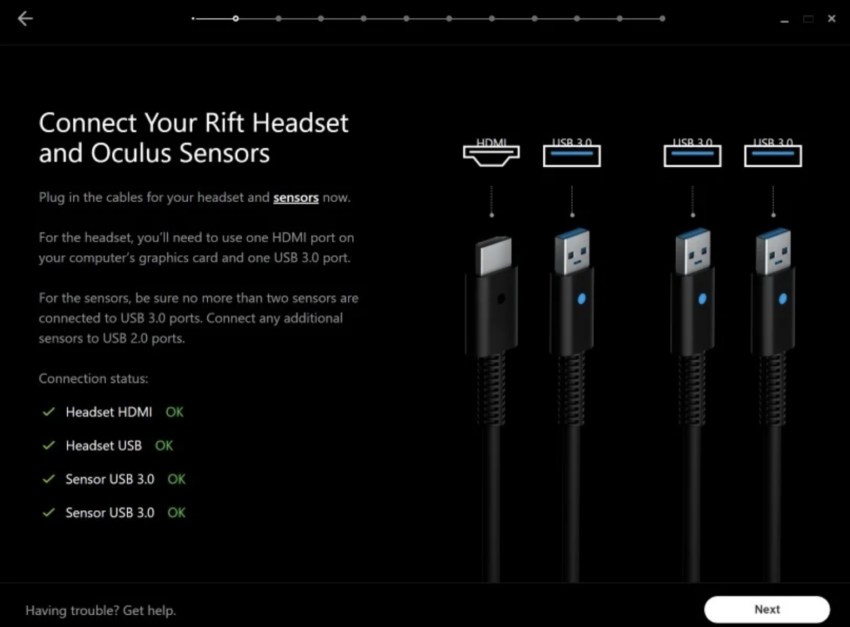
With the software ready, it’s time to connect your Rift hardware. Begin by plugging the two Rift sensors into available USB 3.0 ports on your PC. Next, connect the headset itself: the HDMI cable goes into your graphics card output, and the USB cable into another USB 3.0 port.
Once connected, open the Oculus App. It will recognize each device and display a green checkmark when properly configured. You’ll then pair the Touch controllers and the Oculus Remote by powering them on and following the on-screen pairing prompts. This step ensures your inputs are fully recognized and synced wirelessly.
At this point, the app may push firmware updates to the headset, sensors, or controllers. Keep everything connected until the updates finish, as unplugging can cause errors. Once complete, your hardware is officially recognized and ready for calibration.
3. Defining your play area (Guardian System)
For both safety and immersion, setting up the Guardian System is essential. Place the two sensors three to six feet apart, with their glossy sides facing toward your play space. Ideally, you want an open area of around 10 x 10 feet, but smaller spaces can still work if carefully defined.
Using one Touch controller, draw a boundary around your usable floor space as prompted by the Oculus software. This creates a virtual grid that becomes visible inside VR whenever you get too close to a wall or piece of furniture. Proper Guardian calibration not only keeps you from bumping into real-world objects but also improves tracking accuracy, ensuring the Rift’s sensors capture your movements smoothly.
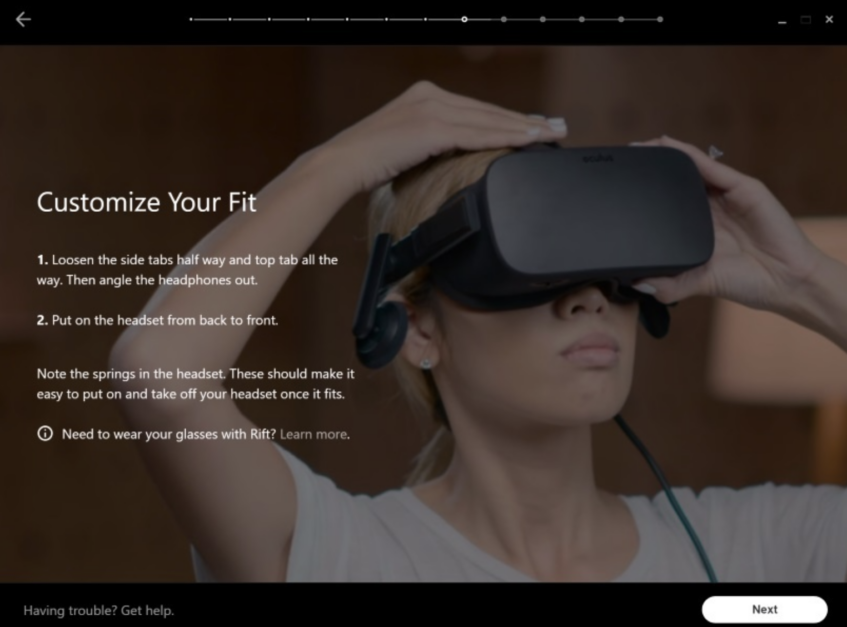
Once complete, adjust your headset fit: straps should be snug but not tight, and lenses should be aligned for the clearest image. With this final stage done, your Rift is ready for immersive VR content.
How to play VR videos
Once your Rift is fully configured, you’ll need to decide how you want to watch your content. The headset supports both browser-based streaming and playback through local video players. Each method has its own benefits, depending on your preferences for convenience, quality, and customization.
Streaming directly from the browser
The easiest way to start is by streaming VR porn directly through the Meta (Oculus) browser. Open the browser from your headset’s menu and navigate to a compatible adult VR website.
Once you’ve chosen a video, press play. The browser may prompt you to enable WebXR. Make sure to accept this option, as it activates the immersive mode required for proper VR playback. Streaming gives you instant access to content without taking up storage on your PC, though performance depends heavily on your internet connection and video resolution.
For smoother playback, close other applications running in the background to free up system resources.
Downloading & watching local files
For the highest quality and the most reliable experience, downloading videos is the better option. Using your PC, visit a trusted VR porn site and save your chosen videos locally.
Then, open a VR video player such as Skybox VR or DeoVR. Both are widely recommended for Rift users and support advanced formats like 3D 180° and 360°. From inside the player, browse to your saved files, select the video, and choose the correct viewing mode (usually 3D 180° for adult content).
Local playback reduces buffering issues, supports higher bitrates than streaming, and allows you to fully enjoy high-resolution videos, including 5K and beyond, if your PC can handle them.
Troubleshooting & best practices
Even with a solid setup, small issues can interrupt your viewing experience. Here are the most common problems you may encounter, and the best habits to keep your sessions smooth, safe, and private.
Troubleshooting common issues
- Performance drops: If videos stutter or lag, check that your PC meets the recommended specs for Oculus Rift and close unnecessary background apps to free up resources.
- Tracking errors: Make sure your sensors are correctly placed, with no obstructions between them and your play area. Re-run the Guardian setup if tracking feels off.
- Format problems: If a video doesn’t display correctly, confirm you’re using the right player (Skybox VR or DeoVR) and the appropriate viewing mode (e.g., 3D 180°). Trying a lower resolution may also improve stability.
Best practices for optimal viewing
- Clear your play area: Use the Guardian System to mark safe boundaries and remove nearby obstacles.
- Adjust your headset fit: Ensure straps and lenses are properly positioned for comfort and clarity during longer sessions.
- Balance quality and performance: High-resolution videos look stunning but may strain your system — find the sweet spot for your PC.
- Protect your privacy: Use headphones for immersive audio and watch in a private space to keep your sessions discreet.
By combining troubleshooting know-how with smart habits, you’ll get the most out of your Oculus Rift while avoiding distractions and discomfort.
Mini-FAQ
Will the Oculus Rift still run on Windows 11 in 2025?
Yes, the Oculus Rift and Rift S still function on Windows 11 in 2025, though support is increasingly community-driven. Meta has shifted focus to the Quest line, so official updates for Rift software are limited. Users may need to apply compatibility settings or patched installers if driver conflicts appear.
While Rift works fine for most setups, performance can vary depending on GPU drivers and recent Windows patches. To maintain stability, keep your graphics drivers up to date, run the Oculus app as an administrator, and check VR forums for community fixes when updates break functionality.
What’s the maximum video resolution/bitrate the Rift S can handle?
The Rift S features an LCD display with 2560 × 1440 resolution (1280 × 1440 per eye), which means that while you can load 4K or even 5K videos, they’ll be downscaled to fit the display. Higher-resolution files can still look sharper due to improved source quality, but the visual benefit flattens out past 5K.
In terms of bitrate, most Rift S users find smooth performance with files up to ~60 Mbps, though this depends heavily on PC specs. If playback stutters, try reducing bitrate or resolution for a balance between visual fidelity and stable performance.
Is it legal to use third-party patched Oculus PC installers?
It exists in a legal grey area. Officially, Meta only authorizes downloads from their own site, and patched installers aren’t licensed or supported. However, many users rely on community-maintained builds when Meta’s updates lag behind OS changes (like Windows 11 patches).
Using them isn’t illegal in most regions if you own the hardware, but it does violate Meta’s terms of service, meaning you’re on your own if problems arise. To stay safe, download only from trusted VR communities and never from random file-sharing sites, as unofficial installers can be bundled with malware.
How do I fix black-screen issues after recent Windows updates?
Black-screen problems are common after major Windows or GPU driver updates. First, check that your graphics drivers are fully updated and compatible with the Oculus software. If the Rift still fails to display, try repairing or reinstalling the Oculus PC app.
Some users report success by disabling Windows’ GPU scheduling feature or rolling back to a previous driver version. Also, make sure your HDMI cable is plugged directly into your dedicated GPU, not the motherboard.
If all else fails, community forums often provide quick patches or registry tweaks tailored to the latest Windows changes.
Can I switch the active OpenXR runtime without uninstalling other platforms?
Yes. Both Oculus and SteamVR install their own OpenXR runtimes, and you can switch between them without uninstalling. In the Oculus PC App, go to Settings → Beta and set Oculus as the active runtime. In SteamVR, the option is available under Developer Settings. Switching simply tells Windows which runtime to prioritize for VR apps.
If you use multiple headsets or platforms, you may need to toggle back and forth depending on the software you want to run. This flexibility allows you to enjoy both Rift-compatible apps and SteamVR-exclusive content without conflict.
From Setup to Sensation
Setting up the Oculus Rift takes some time and preparation, but the payoff is undeniable. Once configured, the headset delivers a uniquely immersive adult entertainment experience that traditional screens simply can’t match.
With crisp visuals, accurate tracking, and the ability to step inside 180° and 360° environments, VR porn on the Rift feels more lifelike and engaging than flat video ever could. For those willing to follow the setup process, the Rift remains one of the most rewarding ways to explore adult content in a fully interactive virtual world.