Adult VR in 2026 looks nothing like the novelty it was even a few years ago. What began as an experimental frontier has evolved into a fully immersive ecosystem shaped by next-generation headsets, AI-enhanced performer experiences, ultra-high-resolution capture, and dedicated adult-friendly platforms that are finally treating VR as its own storytelling medium.
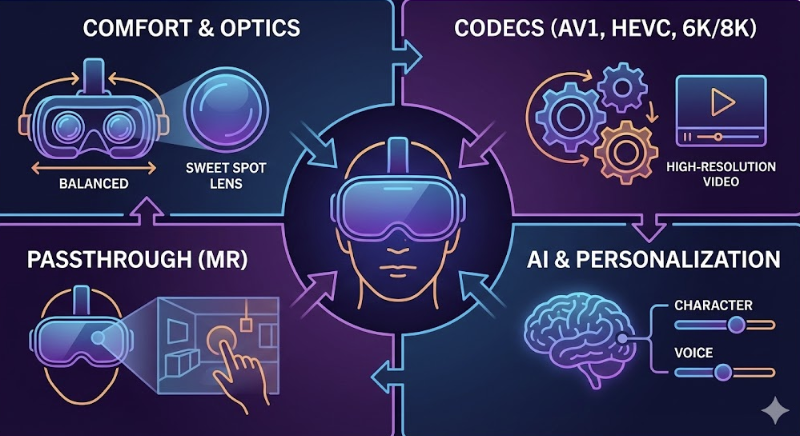
2026 marks a decisive shift for adult VR because four major technologies have matured at the same time: comfort, passthrough, codecs and AI. For the first time, headsets are light enough for extended viewing, stable enough for high-motion scenes and ergonomically shaped so adults can actually enjoy full-length experiences without neck strain or constant readjustment. That alone would have pushed the medium forward, but this year adds another breakthrough.
In this article, we explore the state of adult VR in 2026, the technology pushing it forward, the experiences gaining traction, and the road ahead for both creators and viewers.
TL;DR
- Comfort and optics matter more than raw resolution.
- AV1 is rising, but HEVC is still common. Test both for your device.
- Passthrough adds novelty, but lighting and privacy matter more than apps.
- AI tools can personalize scenes, but always use platforms with clear boundaries.
Hardware Landscape
The hardware side of adult VR has matured faster than any other part of the industry, and 2026 introduces a clear separation between device tiers, performance levels and what viewers can realistically expect from each category.
Standalone headsets, premium PC-VR rigs, PSVR2 and the real state of Apple Vision Pro
Standalone devices have become the backbone of adult VR in 2026. Meta leads this segment with lighter, faster and cooler headsets that finally deliver long-session comfort without sacrificing performance. These “next” models offer stronger color passthrough, improved thermals and decoding power that makes 6K and 8K playback feel effortless.
Premium PC-VR rigs remain the gold standard for enthusiasts who demand the absolute best clarity. Paired with high-end GPUs, they provide unmatched sharpness and smoothness, making them ideal for studios producing upscale VR content.
PSVR2 still has a committed user base, but platform restrictions keep it from being a major force in adult VR. Meanwhile, Apple Vision Pro sits in an unusual position: stunning displays and mixed-reality potential, but a price point and content policies that keep it from becoming widely adopted in the adult space.
Together, these device categories form a balanced hardware ecosystem, each shaping how viewers interact with adult VR content in different ways.
Optics and comfort: lenses, sweet spots, straps and heat management
Optics and comfort are the quiet revolution of 2026. Modern pancake lenses have replaced older Fresnel designs, offering a larger sweet spot, reduced glare and razor-sharp clarity even during movement. This directly improves adult VR because facial details, eye contact and close-range performer interactions remain crisp without constant repositioning.
Comfort improvements follow the same trend. Headsets now use balanced weight distribution and upgraded strap systems that reduce forehead pressure and stabilise the device during still or seated sessions. Breathable materials and refined padding keep heat under control, while improved cooling systems dramatically reduce fogging and overheating.
Playback and Codecs
Playback quality is a defining factor in how immersive adult VR feels, and 2026 brings major shifts in how scenes are encoded, streamed and decoded across different devices. The jump from 4K to 6K and 8K didn’t just require bigger sensors and better cameras.
AV1 vs HEVC, bitrates and the real practicality of 6K–8K VR
Codec evolution is one of the biggest upgrades in adult VR this year. AV1 has become the preferred choice for 2026 because it delivers excellent visual quality at lower bitrates, keeping file sizes reasonable even at 6K and 8K. HEVC (H.265) is still widely used and remains more compatible across older headsets, but its efficiency gap becomes more noticeable as creators push higher resolutions.
For most viewers, 6K VR is now practical on mainstream standalone devices thanks to better decoding hardware and improved thermal performance. 8K VR, however, still sits in the enthusiast tier. It shines on premium PC-VR rigs and top-end standalone models, but its bitrate demands (often 100–180 Mbps for clean motion) limit how widely studios can adopt it.
In short, 2026 is the year 6K becomes standard, while 8K becomes achievable for a growing but still niche audience. AV1 is what makes this possible.
VR players in 2026: HereSphere, DeoVR and viewing essentials
Players matter just as much as codecs, and in 2026 two platforms continue to dominate: HereSphere and DeoVR. Both deliver smooth playback, accurate projection modes and strong optimization for high-resolution adult VR scenes, but each has its own strengths.
HereSphere is the enthusiast’s choice. Its precision projection, custom sharpening controls and advanced motion smoothing make it ideal for users running 6K and 8K scenes on PC-VR rigs or high-end standalone devices. Fine-grain adjustments give viewers more control over how performers appear in close-up shots, helping maintain clarity during movement.
DeoVR remains the most accessible and widely supported player. It’s simple to use, runs well on nearly every modern headset and continues to evolve with stronger AV1 support and more consistent color reproduction. For many viewers, it’s the fastest path to reliable, high-quality playback without tweaking settings.
Together, these players ensure that VR scenes look the way creators intended, whether the viewer prioritizes ease or expert-level tuning.
Mixed Reality and Passthrough: Real Value for Adult Scenarios
Mixed reality has quietly become one of the most impactful shifts in adult VR. While early passthrough features felt blurry and gimmicky, 2026 headsets finally deliver sharp, full-color MR that blends real environments with virtual performers in a believable and highly customizable way.
Why passthrough matters more in adult VR than other categories
Passthrough has a different purpose in adult content than in productivity or gaming. In adult VR, MR allows viewers to place the performer inside their own physical space, turning a bedroom, couch or living room into part of the fantasy. The result is a grounded sense of closeness that makes interactions feel personal rather than purely digital.
This “presence anchoring” effect increases immersion dramatically. Instead of transporting the viewer into a studio environment, mixed reality brings the performer into the viewer’s world, closing the psychological distance between fantasy and physical surroundings.
Full-color MR realism: lighting, depth and spatial accuracy
The quality leap in full-color passthrough is one of 2026’s most important upgrades. Modern headsets now capture real-world lighting, depth cues and object outlines with far greater precision. This allows VR performers to appear naturally integrated into the space rather than floating paper cutouts.
Improved depth mapping also means performers scale correctly relative to furniture and room layout. When paired with accurate shadows and stabilized camera alignment, MR scenes feel less like overlays and more like blended reality.
For adult content, where spatial perception is key to comfort and immersion, this realism is crucial.
Blended reality fantasies: privacy, safety and comfort
MR offers something even traditional VR cannot easily replicate: the ability to shape fantasies without leaving the comfort and privacy of one’s own room. For many viewers, this reduces friction and increases emotional ease.
Experiences become:
- more personal
- more believable
- less dependent on elaborate VR environments
Because MR uses the viewer’s actual space as the stage, it creates a familiar anchor that can make high-intensity scenes feel less overwhelming. Instead of a total escape, viewers get a hybrid scenario that feels intimate but grounded.
AI Personalization: Characters, Voice and Consent Guardrails
AI has become one of the defining forces in adult VR’s evolution, but 2026 is the first year personalization moves from a novelty to a stable, production-ready feature. Studios, platform developers and headset manufacturers now treat AI not as a gimmick, but as a core part of how users shape their experience. At the same time, new consent-focused guardrails ensure that this power is used responsibly.
Custom characters and adaptive performance engines
AI character systems allow viewers to tailor VR performers in ways that were impossible even a few years ago. Instead of swapping between fixed models, users can now adjust personality styles, body proportions, wardrobe preferences and emotional intensity within ethical boundaries set by each platform.
These systems work as adaptive performance engines. They modify facial nuance, pacing, gaze direction and micro-expressions in rhythm with the viewer’s position and behavior. For adult VR, this creates a much closer sense of emotional presence, because the performer no longer behaves like a static recording. They react, adapt and “perform back” in real time while still staying true to the creator’s original design.
AI voice: natural, expressive and ethically sourced
AI voice synthesis in 2026 has reached a level of clarity and emotional precision that makes VR performances feel far more lifelike. Voices now carry breath, warmth, tone shifts and micro-intonations that align more naturally with body motion and viewer proximity.
The biggest change, however, is the shift toward ethically licensed voice models. Platforms now require performers to opt in explicitly before their voice profile can be cloned or adapted. This ensures:
- performers maintain ownership of their vocal identity
- AI voices cannot be generated without documented consent
- studios use transparent datasets instead of scraping or imitation
This framework allows creators and performers to embrace AI enhancements without losing control of how their likeness is used.
Consent guardrails: the core of ethical AI in adult VR
AI personalization raises important questions, and 2026 is the year the industry responds with clear rules. Major adult VR platforms have implemented automated consent guardrails that validate what users are allowed to customize and what falls outside permitted boundaries.
These safeguards prevent:
- creating performers modeled after real people without permission
- using a performer’s likeness outside agreed roles
- generating illegal or non-consensual fantasy content
- altering performer identity in ways that violate their terms
Instead, the systems encourage personalization inside a safe, performer-approved sandbox: wardrobe changes, mood adjustments, environment styles, role-play dynamics and voice variations that the creators have signed off on.
Why responsible AI matters for the future of adult VR
AI unlocks unprecedented intimacy and personalization in VR, but it also introduces risks. In 2026, the adult industry recognizes that sustainability depends on trust: performers must know their identity is protected, while viewers must feel safe exploring fantasies within ethical boundaries.
The combination of adaptive characters, emotionally rich AI voices and strong consent guardrails makes adult VR more immersive without sacrificing respect, agency or safety. It sets the stage for the next era of VR intimacy, where technology enhances connection rather than compromising it.
Safety, Privacy and Discretion
Privacy concerns have always shaped how viewers approach adult VR, and 2026 is the first year the industry seriously tackles payments, identity protection and local media handling. As headsets become more connected and platforms more advanced, the demand for stable, discreet safeguards has grown dramatically.
Payment systems: neutral billing and frictionless anonymity
Adult-friendly payment solutions have evolved significantly in 2026. Major platforms now use neutral billing descriptors that appear on statements without revealing adult-related terms, reducing anxiety for users who want financial privacy. Many services also support prepaid cards, privacy wallets and one-time tokenized transactions, allowing viewers to buy content without storing payment data long-term.
Tokenized payments are especially important because they separate personal information from transaction records. If a platform suffers a data issue, the token—not the actual card number—is exposed. For adult VR, this shift has become a must-have.
Profile separation and identity-safe accounts
Viewers increasingly demand account structures that cannot be linked to their personal or social profiles. In 2026, leading adult VR platforms now support:
- account names that do not require real identity
- separate VR profiles that never connect to a Meta, Apple or Apple ID
- non-social login paths (email or passkeys only)
- local-only watch history options
- auto-clearing activity settings
This separation is critical because most mainstream ecosystems still integrate deeply across apps and devices. Adult VR users benefit from platforms that intentionally avoid this.
Local media privacy: secure storage and offline viewing
Local content handling is another major concern. High-resolution VR files often sit on a device for long periods, and users want assurance that this material stays private. In 2026, platforms have adopted several solutions:
- encrypted local storage for downloaded scenes
- device-level PIN or biometric locks for VR galleries
- offline playback modes that require no account login
- local metadata stripping (no identifiable naming or tags)
These safeguards ensure that personal libraries remain private even if a headset is borrowed, sold or shared.
Comparison Table
| Headset Type | Optics (Clarity & Sweet Spot) | Comfort (Weight & Heat) | Passthrough / MR Quality | AV1 / HEVC Decode Performance | Browser Playback Reliability |
| Standalone (Meta, Pico, “next-gen”) | Very good, large sweet spot with pancake lenses | High comfort, cool operation | Strong full-color passthrough (2026 models) | Excellent AV1, solid HEVC | Good, optimized for most adult platforms |
| Premium PC-VR (Index, high-end Chinese, modded Vision rigs) | Best overall clarity; highest fidelity projection | Depends on strap; still heavier than standalone | Limited passthrough; varies by model | Highest decoding power via GPU | Excellent with HereSphere/DeoVR desktop |
| PSVR2 | Sharp OLED but smaller sweet spot | Comfortable for short sessions | Basic passthrough; not adult-friendly | Strong HEVC; limited AV1 support | Weak, restricted by platform policies |
| Apple Vision Pro | Stunning micro-OLED clarity; top-tier optics | Very comfortable but front-heavy over time | Industry-leading passthrough | Great hardware but limited adult codec playback | Highly restricted; adult content blocked in default browser |
| Travel Mini-Headsets | Good enough for 4K–6K | High comfort, ultra-light | Decent passthrough | Moderate AV1/HEVC; lower thermal budget | Good for simple playback, not heavy sites |
Buying Advice by Use Case
Choosing the right VR headset in 2026 depends less on raw specs and more on how you plan to experience adult content. Different viewers have different needs, and the hardware landscape has finally matured enough that each use case has a clear best fit.
For solo cinematic immersion, high-resolution displays and strong decoding performance matter most. Viewers who want deep emotional presence, crisp facial detail and long-session comfort will benefit from mid- to high-end standalone headsets or premium PC-VR rigs. These devices handle 6K and 8K VR scenes smoothly, offer stable thermals and deliver the clearest optics for intimate, close-up performer experiences.
For couples co-play, versatility is the priority. Shared viewing often involves swapping the headset, adjusting straps and moving between standing and seated positions. Lightweight standalone models with solid passthrough and easy profile switching work best here. They heat less, require minimal setup and make it simple for partners to switch roles without disrupting the moment.
For travelers, portability is king. Compact standalone headsets with strong battery life, good cooling and quick privacy options (profile locks, local-only playback, neutral app icons) offer the most practical experience. These devices are easy to pack, don’t require a PC and allow discreet viewing in hotels or on the go.
Next Steps
The adult VR landscape in 2026 is shaped by smarter hardware, better codecs and more personalizable experiences. What matters most now is choosing gear and platforms that align with how you watch, not just chasing the highest numbers on a spec sheet.
If you’re upgrading or buying for the first time, start with a standalone headset for simplicity, add a trusted VR player like HereSphere or DeoVR and choose platforms that prioritize privacy and performer consent. From there, explore MR features, AI personalization and higher-resolution scenes to shape the adult VR experience that fits your needs.
FAQ
What specs matter most for adult VR realism?
Optics, comfort and decoding performance matter more than raw resolution. A wide sweet spot, good lenses and stable playback create the biggest realism jump.
Do I need 8K to get a sharp image?
No. Modern 6K VR looks extremely sharp on 2026 headsets. 8K is a bonus for enthusiasts with high-end hardware.
Is passthrough/MR actually better than full VR for intimacy?
It can be. MR blends the performer with your real space, which adds grounded closeness. Full VR is still stronger for cinematic fantasy.
Which players handle 6K–8K best?
HereSphere for maximum control and clarity, DeoVR for simplicity and wide device support.
How can I keep my setup private on shared devices?
Use local-only playback, profile locks, neutral app icons, encrypted storage and tokenized purchases. Many platforms now support all of these.